
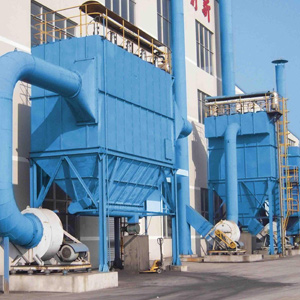
The working principle of a baghouse dust collector consists of a filtration process and a dust cleaning process.
Technical Principle
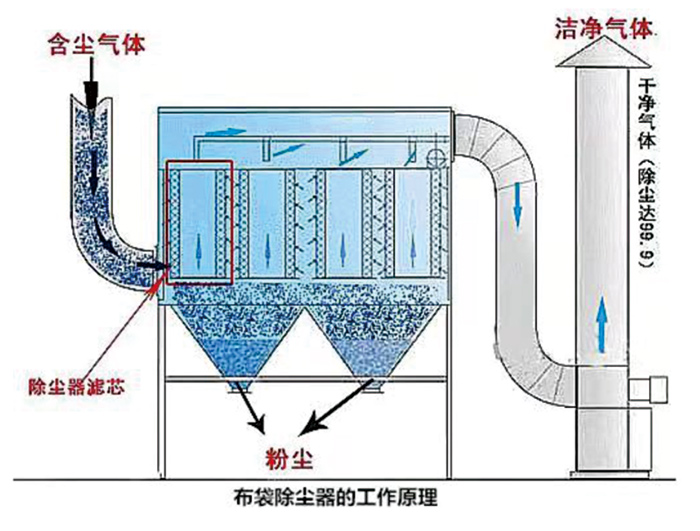
The working principle of a baghouse dust collector consists of a filtration process and a dust cleaning process. Inside each filter bag, there is a cylindrical supporting cage. The dust-laden gas flows from the outside to the inside of the filter bag. Therefore, dust is filtered and collected on the outer surface of the filter bag, while the clean gas passes through the inner side and is discharged from the upper part.
There is no compressed air pipe in the clean room; instead, the pulsed airflow ejected from the compressed air pipe shakes off the dust. Components such as the shell and hopper are kept in a sealed state, similar to the vibration-type design. The dust-laden gas delivered from the upper part of the hopper is split into multiple paths, rising to each filter bag where it is filtered and collected.
The dust concentration of the air treated by the baghouse dust collector ranges from 0.5 to 100 g (dust)/m³ (gas). Therefore, within the first few minutes of operation, an adhesive layer of dust forms on the surface and inside of the filter cloth. This adhesive layer is also called a primary adhesive layer or filter membrane. Once the primary adhesive layer is formed, it takes on the role of filtering and collecting dust. The reason for this is that numerous micro-pores are formed inside the dust layer, with the porosity of the dust layer ranging from 0.8 to 0.9. These micro-pores produce a sieving effect.
The lower the filtration velocity, the smaller the micro-pores and the higher the porosity of the dust layer. Thus, the high-efficiency dust collection process largely depends on the filtration velocity.