
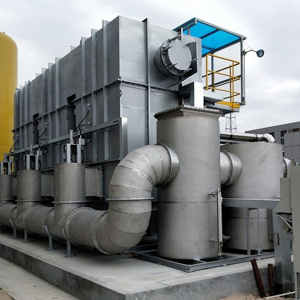
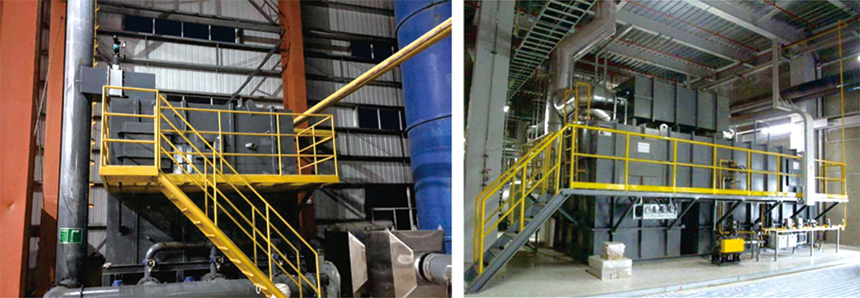
A Regenerative Thermal Oxidizer (RTO) is an energy-saving environmental protection device used to treat medium and low-concentration volatile organic waste gases.
Technical Principle
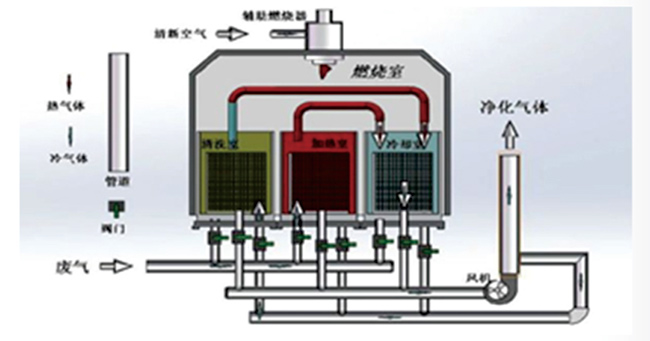
A Regenerative Thermal Oxidizer (RTO) is an energy-saving environmental protection device used to treat medium and low-concentration volatile organic waste gases. Its basic principle is to oxidize organic waste gases at high temperatures to generate CO₂ and H₂O, thereby removing the pollutants. The device is characterized by the integration of a regenerative heat exchanger. Due to its high thermal efficiency (over 96%), it achieves the effect of energy-saving oxidation.
Advantages
Low requirements on working conditions: it can treat waste gases containing most organic compounds;
Wide range of treated air volume: 2,000~300,000 Nm³/h;
High purification efficiency: the purification rate of two-bed RTO is over 96%, and that of three-bed RTO is over 99%;
Automatic control and simple operation; low operating costs;
Low operating expenses: when the VOC concentration reaches 450 ppm, no additional fuel consumption is required; if the VOC concentration is higher, secondary waste heat recovery and utilization can also be realized;
Low maintenance workload, safe and reliable operation;