
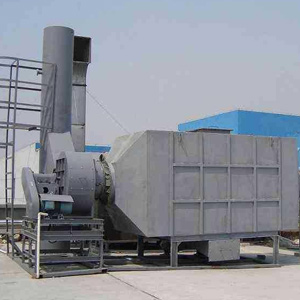
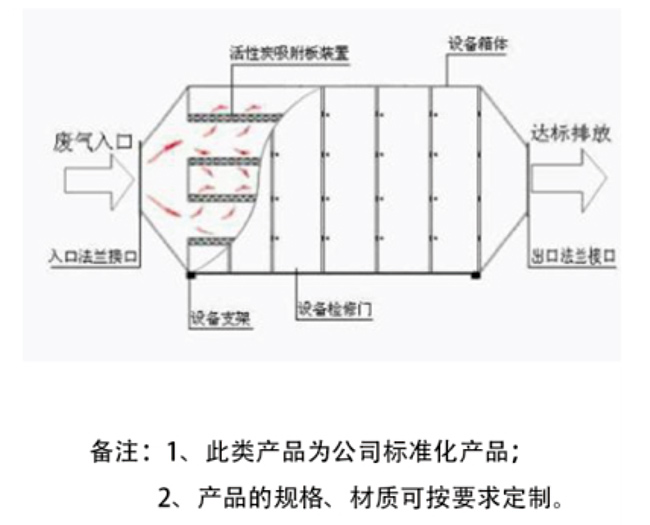
Driven by a fan, the waste gas enters the adsorption tank under negative pressure and then flows into the activated carbon adsorption layer.
Technical Principle
Driven by a fan, the waste gas enters the adsorption tank under negative pressure and then flows into the activated carbon adsorption layer. On the surface of the activated carbon adsorbent, there exist unbalanced and unsaturated molecular gravitational forces or chemical bond forces. Therefore, when the surface of the activated carbon adsorbent comes into contact with the gas, it can attract gas molecules, causing them to concentrate and remain on the surface of the activated carbon. This phenomenon is called adsorption.
By utilizing the adsorption capacity of the activated carbon adsorbent surface, the waste gas is brought into contact with the porous activated carbon adsorbent with a large surface area. Pollutants in the waste gas are adsorbed on the surface of the activated carbon, separating them from the gas mixture, and the purified gas is discharged.
The activated carbon adsorption tank is a type of dry waste gas treatment equipment, composed of a tank body and honeycomb activated carbon filled inside the tank, along with auxiliary components. The activated carbon waste gas purifier is also a dry waste gas treatment equipment. Its tank body and related components can be combined into different specifications. The activated carbon waste gas purifier uses honeycomb activated carbon to adsorb different types of waste gas, and is mainly used for the purification of organic waste gases such as paint fumes.