
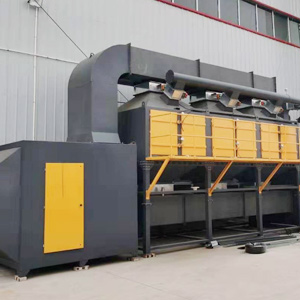
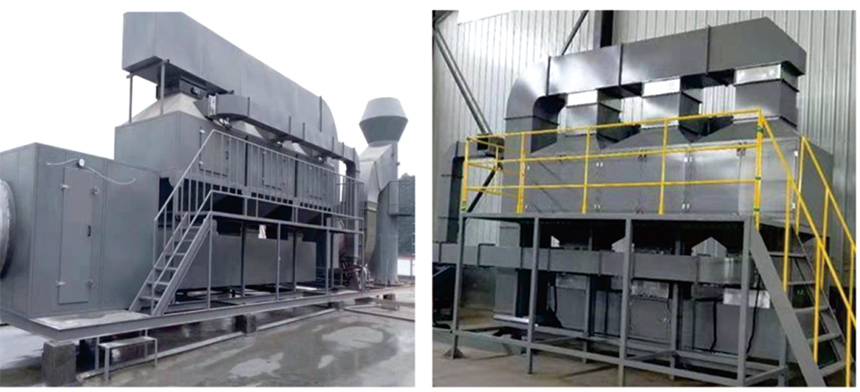
First, the organic waste gas passes through a dry filter to remove some dust particles. Then, the organic waste gas that meets the adsorption conditions is sent to an activated carbon adsorption tank for adsorption and purification.
Technical Principle
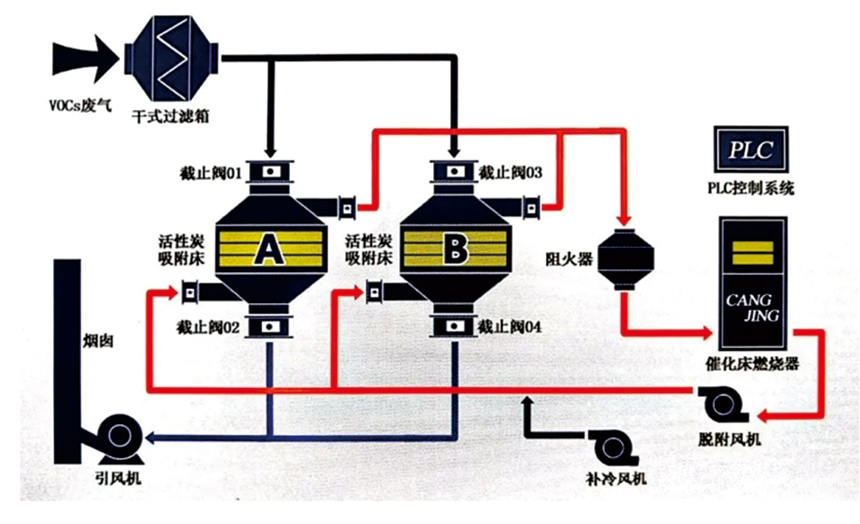
First, the organic waste gas passes through a dry filter to remove some dust particles. Then, the organic waste gas that meets the adsorption conditions is sent to an activated carbon adsorption tank for adsorption and purification. The purified clean gas is discharged into the atmosphere by the main exhaust fan.
The adsorption device is equipped with one set of standby adsorption tank. When the activated carbon is saturated with adsorption, it is switched to the catalytic combustion desorption state through a control valve. The desorption and regeneration system adopts on-line desorption and regeneration, and can also adopt off-line desorption and regeneration. That is, the adsorption process is a continuous treatment process. While the standby adsorption device is put into use, the saturated adsorption tank performs desorption work. After desorption, the activated carbon tank is ready for the next cycle of use.